



Frequently Asked Questions
What are hardware crimp terminals?
Hardware crimp terminals are electrical connectors that join a wire to a terminal point without soldering. A crimping tool compresses the terminal barrel around the conductor, forming a secure mechanical and electrical bond. They are typically made from brass or copper alloys with tin plating for corrosion resistance. Zierick’s crimp terminals, for example, use C26000 brass.
These terminals are used in PCB assemblies and industrial wiring where reliable, repeatable connections are required. Unlike soldered terminals, crimped joints are made cold, reducing the risk of heat damage to nearby components and speeding up assembly in high-volume production environments.
How do crimp terminal connectors differ from standard connectors?
Crimp terminal connectors secure a wire by compressing a metal barrel around the conductor and can produce a gas-tight connection when properly crimped. Standard connectors may rely on friction, clamping, or soldering, which introduce more variability in connection quality. The crimping process is repeatable and easier to inspect at the assembly stage.
Crimped connections often provide stronger pull-out resistance and improved vibration tolerance compared to soldered joints. Some connector systems allow a crimped terminal and wire to be removed and replaced without damaging the housing or board. This makes crimp terminal connectors a practical choice where serviceability and consistency matter.
What are PCB crimp terminals and why are they used?
PCB crimp terminals combine a crimp barrel with a through-hole PCB lead, letting a single component accept a crimped wire on one end while mounting directly to a circuit board on the other. The leads insert into PCB holes and are wave or hand soldered to the board during assembly, while the crimp barrel secures the wire conductor.
This combination suits industrial controls, automotive electronics, and consumer devices where wiring must connect to a board without a separate housing. Eliminating wire-side soldering speeds up assembly, reduces cold joint risk, and produces a compact termination that performs well in demanding conditions.
What materials are electrical crimp terminals made from?
Electrical crimp terminals are most commonly manufactured from brass or copper alloys. Brass, particularly C26000, offers a reliable balance of conductivity, mechanical strength, and formability. It is the material Zierick uses across its crimp terminal range. Copper alloys are selected in applications where higher conductivity is the priority.
Most terminals also feature tin plating, which improves corrosion resistance and extends service life across varying environmental conditions. The combination of a quality base metal and a protective finish allows electrical crimp terminals to perform consistently across a wide range of temperatures and application requirements.
What are the common industrial applications of crimp terminals?
Crimp terminals appear in nearly every industry where wired connections need to be secure and consistent. Automotive assemblies are among the most common applications, with industrial crimp terminals used throughout wiring harnesses to connect sensors, actuators, and power circuits. Industrial control panels rely on them to terminate field wiring to relays and PLCs, and power distribution systems depend on them to handle sustained loads reliably.
Beyond those, aerospace, heavy machinery, and consumer electronics all make regular use of crimp terminals. Aerospace and heavy machinery demand vibration resistance and mechanical integrity, while consumer electronics favor a compact footprint and assembly efficiency.
What types of crimp terminals are available?
Crimp terminals come in several configurations suited to different connection needs:
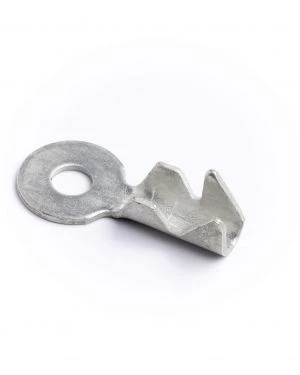
- Ring terminals fit over a stud or screw and are common in grounding and power applications.
- Spade or fork terminals allow connection and disconnection without fully removing a screw.
- Butt connectors join two wire ends in-line, while pin terminals insert into connector housings.
- Blade terminals provide a flat tab interface for quick-disconnect use.
Terminals are also classified as insulated or non-insulated. Insulated versions include a protective sleeve that aids identification by wire gauge, while non-insulated terminals are used where space is limited or separate insulation is applied.
How do you choose the right wire crimp terminal?
Selecting the right wire crimp terminal starts with wire gauge. The terminal barrel must match the conductor size to produce a reliable crimp, and most terminals specify an AWG range for this reason. The current rating must also align with the circuit load to prevent overheating at the connection point.
Material and finish matter in harsher environments, where tin-plated terminals offer better corrosion resistance. High-vibration installations call for terminals with strong mechanical crimp specifications. Operating temperature range and exposure to moisture or chemicals should also factor into material selection and the choice between insulated and non-insulated options.
Why is quality important in crimp terminals?
Low-quality crimp terminals can use inconsistent base metals or thin plating that degrades under heat and humidity, increasing resistance at the connection and creating failure points over time. In safety-critical applications, the consequences of a failed terminal connection are significant and costly to address after installation.
High-quality crimp terminals deliver consistent barrel dimensions and material hardness, keeping crimp force and pull-out resistance predictable across high-volume production runs. This consistency supports compliance with safety standards and reduces the long-term costs associated with rework and field failures, which quickly outweigh any short-term savings from lower-grade components.
What specifications should I check before buying crimp terminals?
Review the crimp terminal specifications to verify that the wire gauge range matches your conductor size, as a mismatch affects compression quality and current-carrying capacity. Check the current rating against your circuit requirements and confirm that the operating temperature range is suitable for your environment, particularly for automotive or industrial use.
Review the base material and finish for corrosion resistance where exposure to moisture or chemicals is likely. For regulated industries, look for UL or RoHS compliance documentation. Verify that the mounting style, whether ring, spade, pin, or another format, aligns with your board layout or panel design before ordering.
Can crimp terminals be used in automotive applications?
Crimp terminal applications in automotive wiring are extensive and well established. Vehicle vibration levels can degrade unsupported soldered wire connections, while a properly crimped joint maintains integrity under continuous mechanical stress. Automotive-grade terminals are also rated for elevated temperatures found near engines and braking systems, where thermal performance is a key selection criterion.
Wiring harnesses throughout a vehicle depend on crimp terminals to maintain circuit integrity across the vehicle’s lifespan. For custom harness work, terminals are matched to wire gauge, current requirements, and connector housing compatibility to ensure the completed assembly meets the relevant automotive standards for strength and durability.